Why it matters
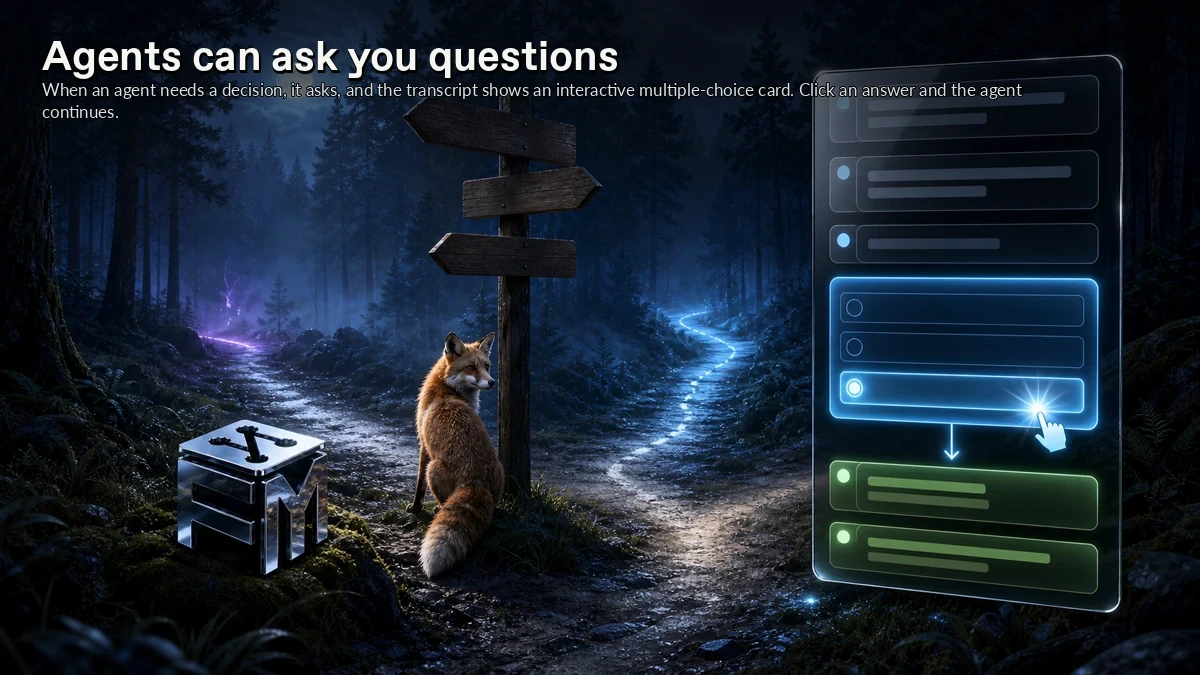
Agents can ask you questions gives ForkMesh a concrete mechanism for interactive decision cards that let agents stop and ask instead of guessing. When an agent needs a decision, it asks, and the transcript shows an interactive multiple-choice card. Click an answer and the agent continues.
AI coding only helps when the agent can work in a real repository without trampling human state or hiding what it did. In ForkMesh, agents can ask you questions addresses that need at the feature level, keeping the behavior close to the repository instead of buried in a detached hosted layer.
How ForkMesh handles it
ForkMesh handles agents can ask you questions through the same split it uses across the product: ForkMesh runs agents beside the repository, capturing transcripts, branches, diffs, prompts, usage, questions, and handoffs in the desktop app.
The behavior is intentionally narrow: When an agent needs a decision, it asks, and the transcript shows an interactive multiple-choice card. Click an answer and the agent continues. Humans keep control of instructions, answers, review, and merge decisions.
Where it fits
Use agents can ask you questions when agent work should be reviewable, resumable, and connected to the same repo UI humans use.
It pairs with the rest of AI agents, built in because Agents can ask you questions keeps interactive decision cards that let agents stop and ask instead of guessing connected to the repository, its signatures, and the nodes that serve it.