Why it matters
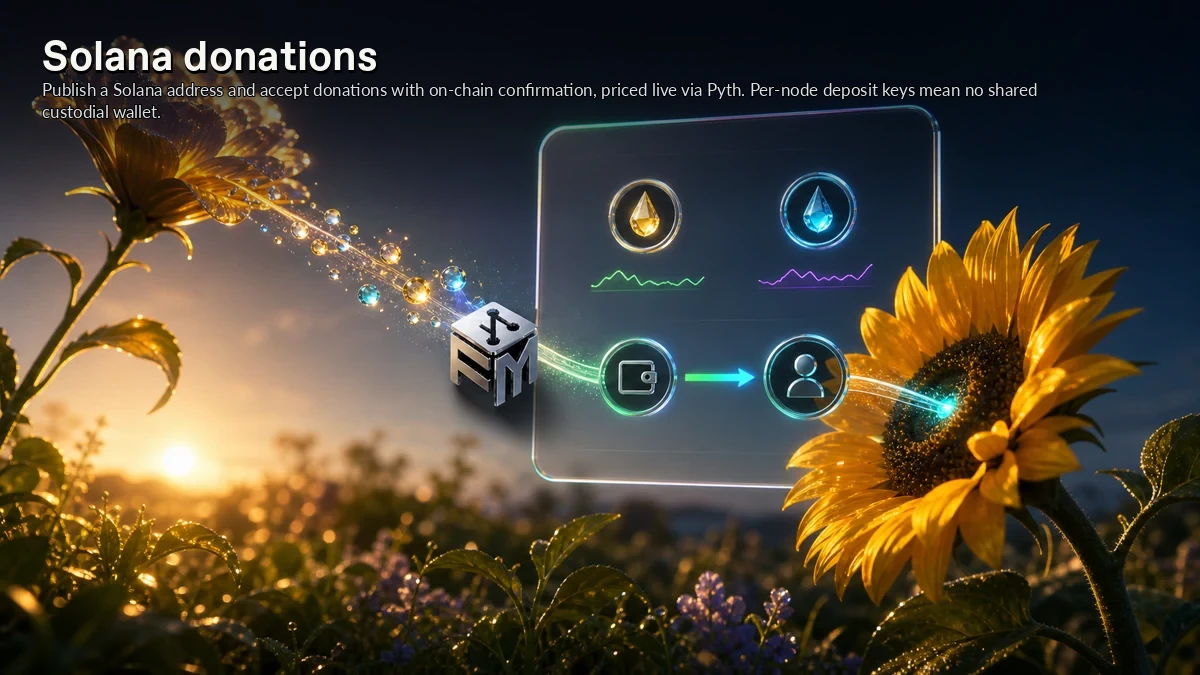
Voluntary on-chain support can help independent mirror operators without turning ForkMesh into a bank. A node publishes only its public payout address. A contributor approves a reference-bound transfer in their own wallet and ForkMesh independently verifies finality on the configured Solana network.
Preservation costs time, disk, bandwidth, and maintenance, so incentives need to point at the nodes and people doing the work. In ForkMesh, Solana donations addresses that need at the feature level, keeping the behavior close to the repository instead of buried in a detached hosted layer.
How ForkMesh handles it
ForkMesh links a signed node identity to a valid public address. For the community pool, the website prepares—but never signs—a transfer from the contributor’s wallet to one visible public pool address. The first instance owner’s Qt client keeps the pool signer locally encrypted and requires explicit approval before an outgoing reward is signed.
The interface separately labels user-owned funds, the community-funded pool, pending allocations, and finalized on-chain transfers. Transaction signatures link to the public explorer, and no visual animation counts as settlement.
Where it fits
Use direct contributions when you want transparent public settlement and are comfortable approving the transaction in a self-custodial wallet. Never send funds to an address or network you have not independently verified.
Participation in ForkMesh never requires a contribution, and a public payout address is not proof that a node is healthy or trustworthy.