Why it matters
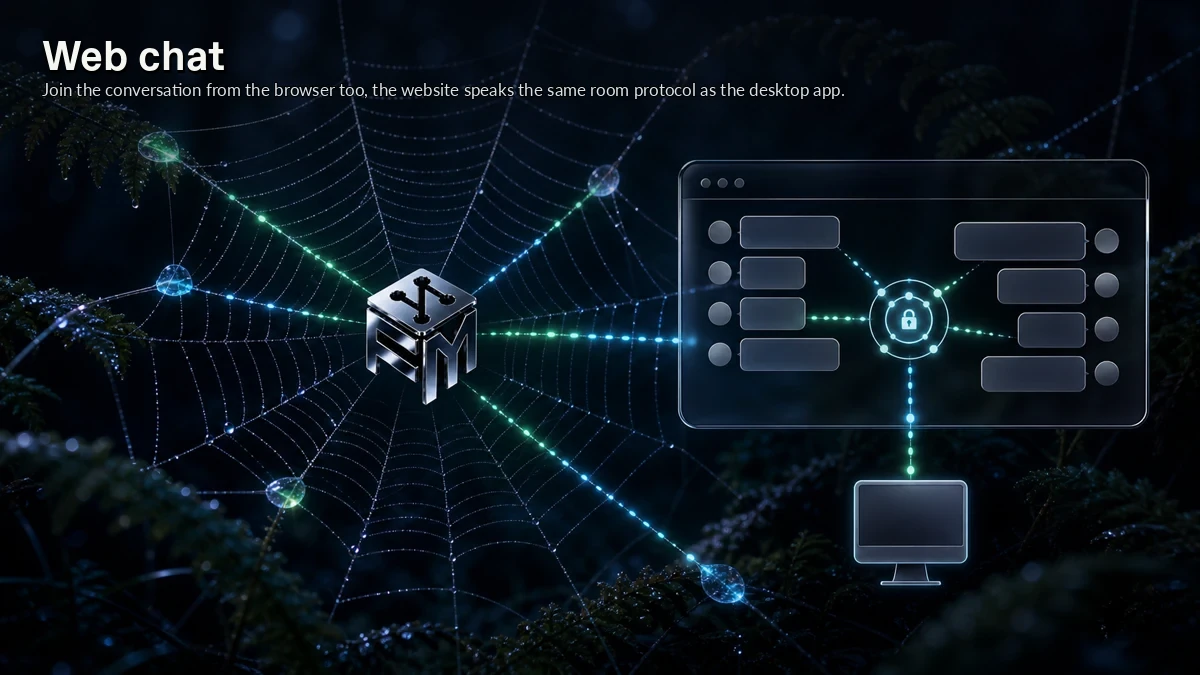
Web chat gives ForkMesh a concrete mechanism for browser participation in the same room protocol as the desktop app. Join the conversation from the browser too, the website speaks the same room protocol as the desktop app.
Project conversations often carry design, access, and coordination context, so web chat states the relay trust boundary directly.
How ForkMesh handles it
The website uses the same AES-256-GCM envelopes as desktop and Flutter. It fetches the default shared passphrase from the relay after authentication, so the relay operator can derive the key and decrypt messages.
The mainnode retains only marked history, capped at the newest 500 persisted frames per room for 7 days.
Where it fits
Use web chat when teams need repository-aware conversation and accept the relay operator in the trust boundary.
It pairs with the rest of Chat & private sharing because Web chat keeps browser participation in the same room protocol as the desktop app connected to the repository, its signatures, and the nodes that serve it.