Why it matters
Independent mirrors spend disk, bandwidth, and operator time keeping code available. ForkMesh can recognize that work with small voluntary community incentives without promising income or taking custody of a node operator’s wallet.
Preservation costs time, disk, bandwidth, and maintenance, so incentives need to point at the nodes and people doing the work. In ForkMesh, mirror rewards addresses that need at the feature level, keeping the behavior close to the repository instead of buried in a detached hosted layer.
How ForkMesh handles it
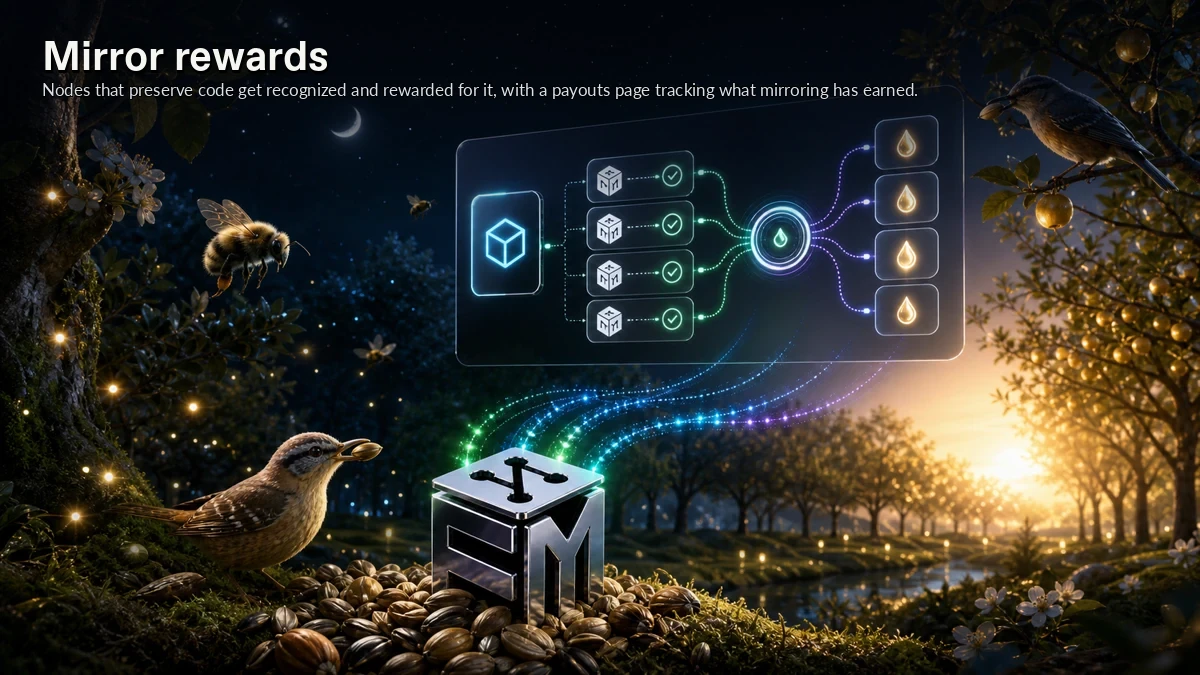
Each configurable round evaluates server-observed signed identity, fresh HTTPS health, a signed integrity proof for the ForkMesh repository, abuse status, minimum uptime or contribution, and a valid public payout address. Candidates are deduplicated across node, operator, wallet, and device before deterministic selection from public finalized-chain entropy.
Approved federated relays must forward the original node-signed registration and fresh, nonce-bound ForkMesh repository-health message. The main relay verifies both signatures and the current refs digest; a relay-reported wallet and name by themselves are never reward eligibility.
The Worker produces an unsigned exact transfer plan. The first instance owner’s Qt client keeps the community-pool key locally encrypted, requires explicit confirmation, signs locally, and returns only a public transaction signature. The Worker marks completion only after the exact transfer reaches finality.
Where it fits
The public status view exposes the pool address, network, finalized transaction history, eligibility snapshot hash, selection proof, rejection counts, and documented Sybil limitations.
Running a mirror does not guarantee selection or payment, and an online node is not automatically trustworthy.