Why it matters
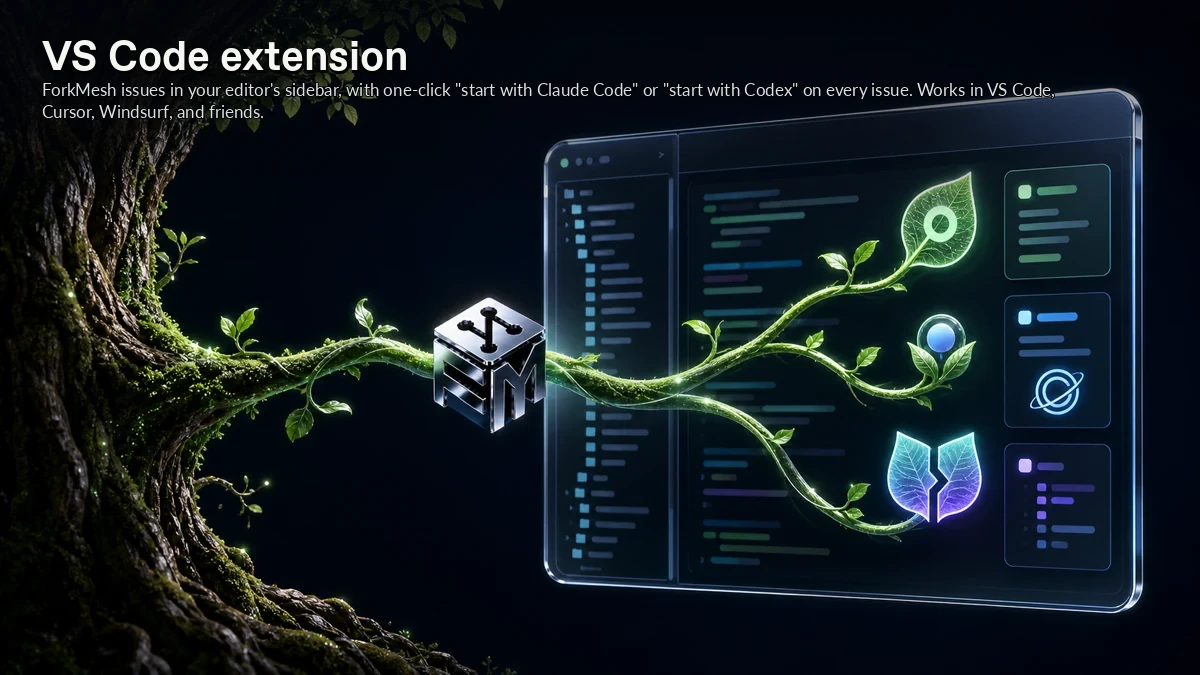
VS Code extension gives ForkMesh a concrete mechanism for ForkMesh issues and agent handoffs inside familiar editors. ForkMesh issues in your editor's sidebar, with one-click "start with Claude Code" or "start with Codex" on every issue. Works in VS Code, Cursor, Windsurf, and friends.
A distributed forge still needs clean entry points for readers, contributors, mobile users, and editor workflows. In ForkMesh, VS Code extension addresses that need at the feature level, keeping the behavior close to the repository instead of buried in a detached hosted layer.
How ForkMesh handles it
ForkMesh handles VS Code extension through the same split it uses across the product: ForkMesh exposes web, mobile, editor, docs, status, and clean URL surfaces on top of the desktop-node and mainnode model.
The behavior is intentionally narrow: ForkMesh issues in your editor's sidebar, with one-click "start with Claude Code" or "start with Codex" on every issue. Works in VS Code, Cursor, Windsurf, and friends. Those surfaces route to live or mirrored data; they are access layers, not the canonical Git store.
Where it fits
Use VS Code extension when people need to browse, contribute, learn, and receive updates outside the main desktop window.
It pairs with the rest of Mobile, web & IDE because VS Code extension keeps ForkMesh issues and agent handoffs inside familiar editors connected to the repository, its signatures, and the nodes that serve it.